How to handle chargebacks on a game server
Why game servers get chargebacks, how Stripe and PayPal disputes work, what evidence to send for a rank or item, and how to prevent the next one.

Tanz
6 min read
A chargeback is a buyer asking their bank to reverse a payment. When your store pays into your own Stripe or PayPal account, the case is yours: the disputed money is held or taken from your balance (plus a fee, on Stripe), you get a short deadline to answer, and someone else decides. For a rank or an in-game item, your best evidence is a record that the purchase reached the player's account and was used after the payment.
Most of the work happens before any dispute exists. PayPal's merchant guide puts it plainly: "The most effective way to reduce disputes is to prevent them". For a server, that means a clear product page, a refund policy the buyer agrees to at checkout and fast answers in your support channel.
Why game servers get chargebacks
The payment providers' own documentation lists the usual causes, and all of them show up in server stores:
- Stolen cards. Stripe says "Most fraudulent payments are made using stolen cards or card numbers." The real cardholder finds the charge and disputes it.
- Friendly fraud, which Stripe defines as a legitimate cardholder who makes a purchase "but then disputes it at a later date", either because they didn't recognize the charge or on purpose, out of buyer's remorse or to get the goods for free.
- Someone else in the house using the card. PayPal's merchant guide lists unauthorized transactions where the card "was stolen or used by an unauthorized family member". A kid buying a rank with a parent's card is this case.
Stripe calls fraud "the most common reason for a dispute" and also "a difficult dispute type to win because in many cases the reason for the dispute is correct." When the card really was stolen, accepting the dispute is often the honest answer.
The cost goes beyond the sale. On Stripe, the bank takes the disputed amount back and Stripe charges a dispute fee. In the United States, Stripe's dispute pricing lists 15 USD for each dispute you receive and another 15 USD if you counter it. The second fee comes back if you win; the first one does not, unless your Stripe contract says otherwise.
Who answers the dispute
That depends on who sold the item to the player.
A merchant of record resells your items in its own name, so the dispute is filed against it. Tebex works this way, and its seller protection page says that if a buyer starts a chargeback, "Tebex will defend it on your behalf", adding that "Not all payments are eligible."
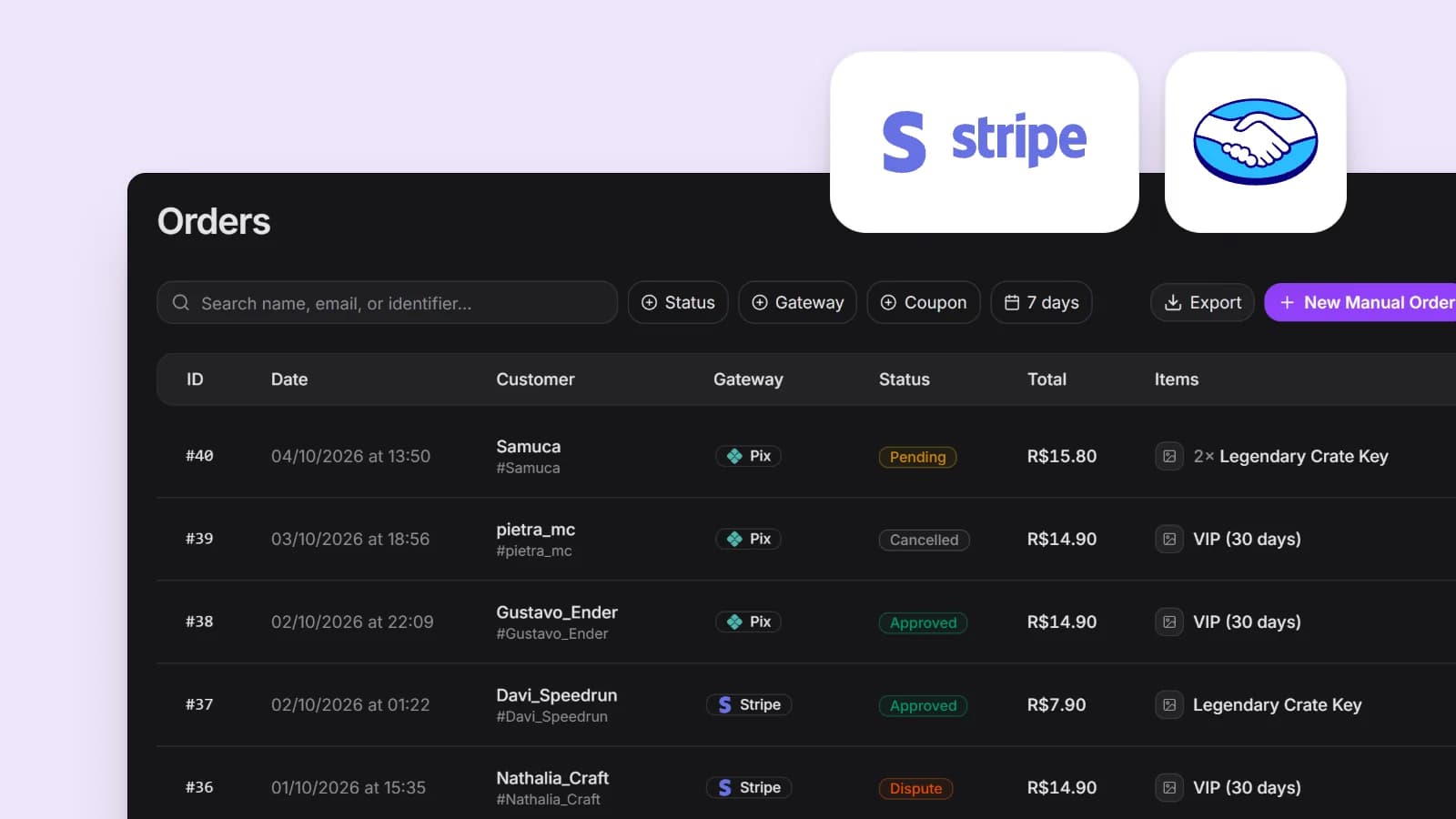
When the store charges through your own payment account, as Gamecart does, the dispute is opened against that account and you answer it in your provider's dashboard. Gamecart never holds the money, so it is not a party to the case. The Gamecart vs Tebex comparison covers the trade-offs of each model.
How a dispute works on Stripe
Stripe notifies you by email, in the Dashboard and through a charge.dispute.created event. From there:
- Stripe debits the disputed amount plus the fee, and the funds stay held until the case ends. While the dispute is open, you can't refund the payment outside the dispute process.
- You have a short window to respond, usually 7 to 21 days, depending on the card network. No answer means you lose automatically.
- In the Dashboard, open the dispute and pick Accept dispute or Counter dispute. Countering opens a form that asks for evidence based on the dispute category.
- Stripe states: "You've only one opportunity to submit your response." You can't edit it or add files later.
- The bank decides, which can take up to 3 months. The result is
wonorlost, and a lost dispute is final.
Some networks start with an inquiry before a formal chargeback. Stripe says you can resolve an inquiry without a dispute fee by answering with satisfactory evidence or by issuing a full refund, so treat inquiries as urgent.
How a dispute works on PayPal
PayPal has its own process when the buyer complains to PayPal instead of the bank. The buyer opens a dispute in the Resolution Center, and there is "usually a 20-day period" before it can be escalated to a claim. Once there is a claim, PayPal's merchant guide says "the seller is asked to respond within 10 days", or the claim closes in the buyer's favor with a full refund. PayPal says the review "usually takes about 30 days".
To answer, open the Resolution Center, click Respond next to the claim and follow the steps. PayPal warns that after you upload files "you won't be able to view them again", so keep your own copies.
A buyer who paid through PayPal with a card can also go straight to the card issuer. That is a card chargeback, decided by the bank.
PayPal's Seller Protection (for accounts with a primary address in the US) can cover intangible goods, with extra conditions: for unauthorized transaction claims, PayPal must have marked the transaction as "eligible" on the Transaction Details page, and you need proof of delivery. For digital goods, that proof is "a system of record showing the date the item was sent" and that it was either sent electronically to the recipient or "Received or accessed by the recipient." Check each transaction's page before you count on it.
What evidence works for a rank or an in-game item
Stripe's guidance for digital products is to "focus on evidence of usage, login, or download". For fraud claims it recommends the customer's name, email, IP address at the time of purchase, and "Server or activity logs showing proof that the customer accessed or downloaded the purchased digital product after they made the payment."
On a game server, that translates to:
| What the provider asks for | What a server owner can show |
|---|---|
| Name and email of the customer | The buyer's details on the order |
| IP address at purchase | Whatever your payment record shows; check the payment page in your provider's dashboard |
| Activity after the payment | The delivery command with its time and status, plus your server log showing that username joining after the purchase |
| Product as described | A screenshot of the product page: what the rank includes, for how long, on which server |
| Policy the buyer accepted | A screenshot of the checkout showing your refund policy |
| Contact with the buyer | Support tickets or Discord messages, exported to PDF |
Stripe also accepts evidence "that the transaction was completed by a member of the cardholder's family or household". If the buyer's account belongs to the cardholder's child and your records show it, say so.
Format matters. Stripe says banks "won't review any external content", so no videos and no links to files. Combine the files of each evidence type into a single document, keep the total under 4.5 MB, and write a short summary that matches the dispute reason.
A prevention checklist
- Use a recognizable statement descriptor. Stripe recommends your website domain or business name, between 5 and 22 characters. A buyer who doesn't recognize
PAYMENT*X7Qon their statement may report it as fraud. - Describe each product exactly. Say what the buyer gets, for how long and on which server or game mode. "VIP rank, 30 days, Survival server" leaves less room for an item-not-as-described claim than "VIP".
- Show the refund policy at checkout. Stripe suggests showing the full terms on the checkout page and requiring agreement before the order goes through, instead of only linking to them.
- Keep the delivery records. Stripe's advice for digital goods: "maintain access logs or documentation that tie usage back to the customer." Don't rotate server logs away before the dispute window closes.
- Answer support quickly. A refund you issue yourself costs no dispute fee. A buyer who can't reach you goes to the bank.
- Refund obvious fraud early. When the card issuer flags a payment as fraud, refunding before a dispute can cost less than fighting one. For Stripe's early fraud warnings, Stripe's analysis puts that point at charges "roughly less than or equal to your dispute fee".
Removing the perk after a chargeback
When the bank returns the money to the buyer, removing what that payment bought is the proportionate response. Take back the rank or the item and leave it there.
Warning
Banning a player over a chargeback is a different decision. If you do it, write the rule into the terms the buyer accepts before paying, apply it the same way to everyone, and check your local consumer law first. Never use a ban, or the threat of one, to pressure someone into withdrawing a dispute.
If the bank later rules in your favor, give the perk back.
What Gamecart records for you
Gamecart doesn't handle disputes, since the payment is in your account, but it keeps the records you need for the evidence:
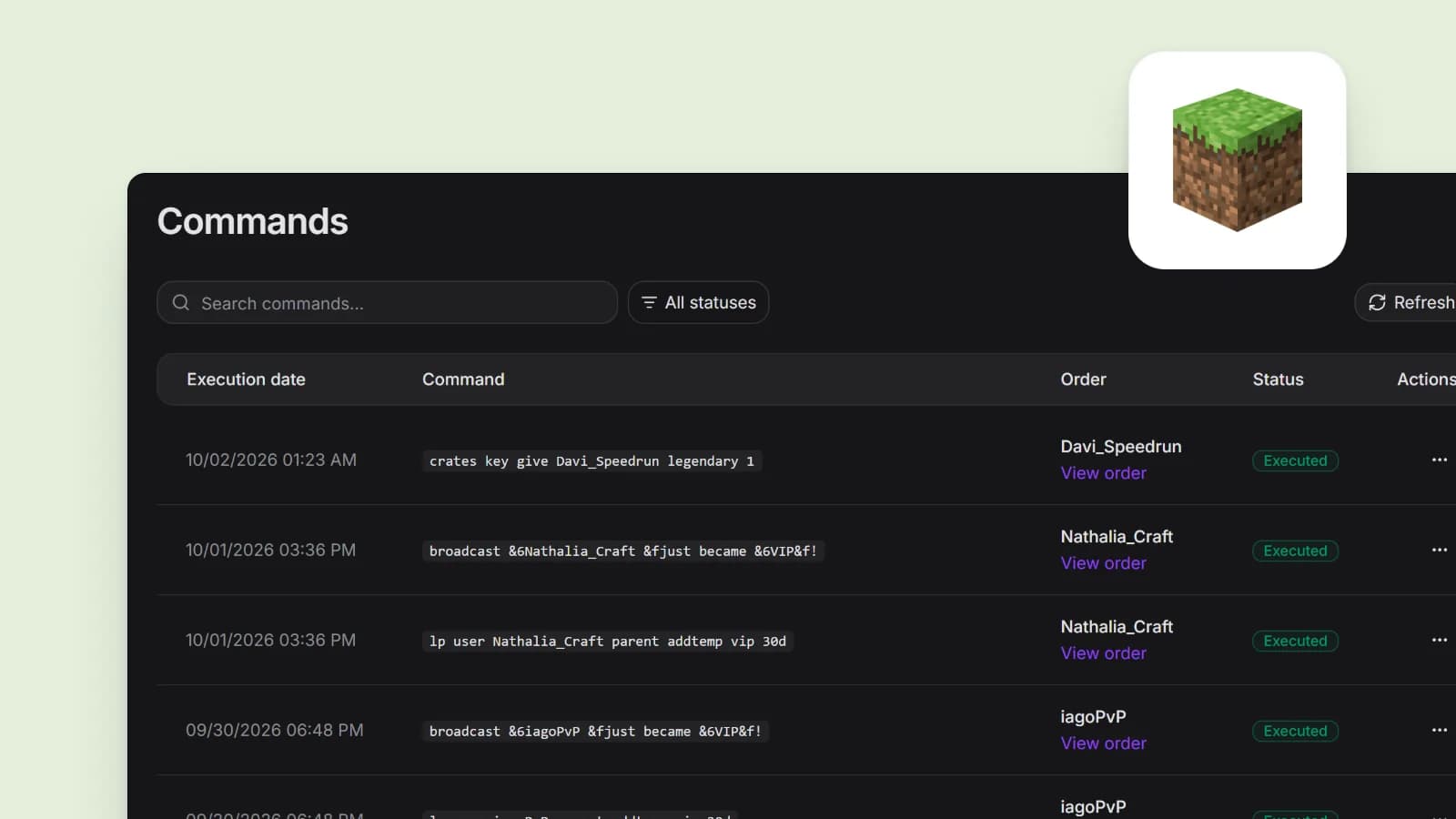
- Integrations > Commands lists every delivery command with its status. Executed means Gamecart recorded the delivery as complete, which you pair with your server log as proof.
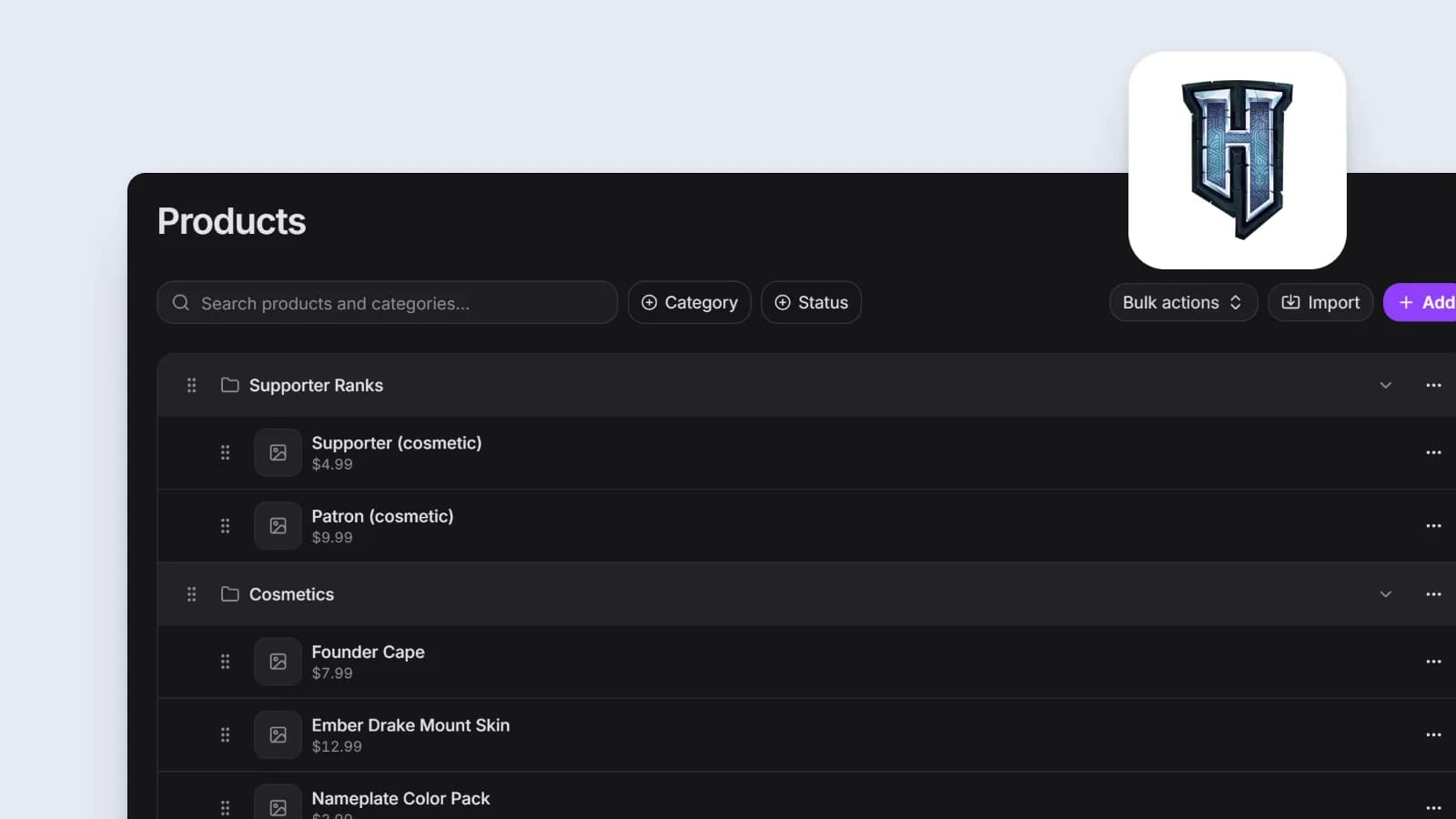
- Products accept commands with the On Dispute trigger, which also runs on refund, rejection and cancellation. Use it to take the perk back, for example
lp user {identifier} parent remove vip. See configure product delivery commands. - The dashboard can send push notifications for disputes and refunds, so you see the case before the deadline gets close.
- On the Enterprise plan, the Seller API lists the commands of each order, keeps internal order notes that only you see, sends an
order.payment_disputewebhook, and can mark an order as refunded. That last call only records the refund in Gamecart. It does not refund at the payment provider.
Sources
- https://docs.stripe.com/disputes/how-disputes-work
- https://docs.stripe.com/disputes/responding
- https://docs.stripe.com/disputes/categories
- https://docs.stripe.com/disputes/prevention/fraud-types
- https://docs.stripe.com/disputes/prevention/best-practices
- https://support.stripe.com/questions/june-2025-pricing-updates-for-disputes
- https://www.paypal.com/us/brc/article/customer-disputes-claims-chargebacks-bank-reversals
- https://www.paypal.com/us/legalhub/paypal/seller-protection
- https://docs.tebex.io/creators/tebex-checkout/seller-protection-and-chargebacks

About the author
Tanz
Founder of Gamecart, the store platform for Minecraft, Hytale, FiveM, and other game servers.
Open your server store
Create a free Gamecart store, connect your server, and deliver purchases automatically.